John Quincy Adams and American Global Empire by William Earl Weeks
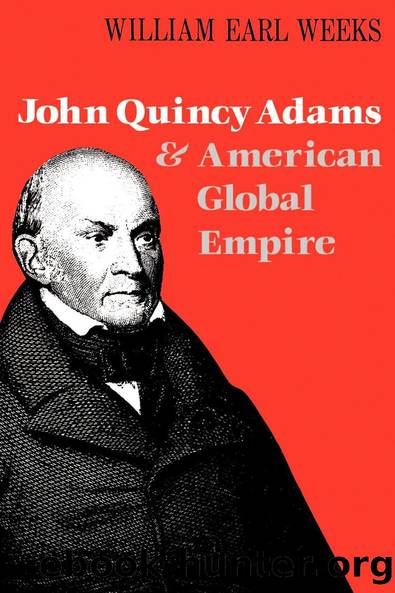
Author:William Earl Weeks [Weeks, William Earl]
Language: eng
Format: epub
Tags: Nonfiction, Social & Cultural Studies, Political Science, International, Treaties, History, Americas, United States, 19th Century, Biography & Memoir, Political
ISBN: 9780813184098
Publisher: The University Press of Kentucky
Published: 2021-10-21T04:00:00+00:00
Map 4. The Proposals of July and October 1818 (projected on the Melish map of 1818)
One might wonder why OnÃs, confronted by overt aggression against the possessions of his country, would continue to negotiate with Adams. The simple fact is that he had no choice. To break off the talks now, with Jackson in Florida and no European powers emerging to assist Spain, would invite the Americans to take possession not only of the Floridas but of Texas as well. Spain was in danger of losing, without compensation, all the territories the United States coveted. OnÃs urged Pizarro that he be allowed to make the best deal possible, noting that Spainâs bargaining position âcertainly wonât be better for a long time.â51
The map of Spanish North America showed OnÃs an empire besieged. Jacksonâs invasion was only the latest assault. American troops still occupied Amelia Island. In Texas, Bonapartist exiles under the command of Henri LâAllemand were plotting to seize the province, preparing one more in a long line of guerrilla attacks on the Gulf Coast region.52 Galveston remained occupied by the Lafitte gang, whose privateers harassed Spanish shipping, hindering resupply efforts. OnÃs recognized that Spain could not defend its interests militarily and that no European power had shown any inclination to do so. Spain stood alone in its dispute with the United States, and OnÃs had sufficient experience as a diplomat to know that no matter how humiliating, he must continue the negotiations or invite further American aggression. This explains the infinitely understanding tone of his letters of protest, as he contrived to give the administration every benefit of the doubt regarding the invasion of Florida. In an implacably difficult position, OnÃs swallowed hard and prepared to make the best deal he could.
The breakthrough on the western boundary question also explains the zeal with which Adams defended Jackson in the July cabinet meetings. While the administration debated what to do about events in Florida, Adams had already gotten a taste of a potentially monumental transcontinental boundary which whetted his already substantial appetite for a treaty with Spain.
During July 1818 the focus of the negotiations shifted from the acquisition of the Floridas (Spainâs cession of them being already assured) to the delineation of a transcontinental boundary between Spanish possessions and the United States. The question remains, why did Monroe and Adams now propose a boundary to the Pacific? All previous demands had extended no further west than the front range of the Rockies. Was it because, as Bemis suggests, Monroe and Adams had not previously understood the relationship between the Anglo-American Northwest boundary question and the Spanish-American dispute in the Southwest?53
This explanation does justice neither to Monroe and Adams nor to the facts of the situation. The president and his secretary of state, with nearly fifty years of diplomatic experience between them, could not have overlooked the implications of defining a western boundary with Spain east of the Rockies while still contending with Great Britain and Russia for control of the Northwest.
Download
This site does not store any files on its server. We only index and link to content provided by other sites. Please contact the content providers to delete copyright contents if any and email us, we'll remove relevant links or contents immediately.
| Arms Control | Diplomacy |
| Security | Trades & Tariffs |
| Treaties | African |
| Asian | Australian & Oceanian |
| Canadian | Caribbean & Latin American |
| European | Middle Eastern |
| Russian & Former Soviet Union |
The Secret History by Donna Tartt(19088)
The Social Justice Warrior Handbook by Lisa De Pasquale(12190)
Thirteen Reasons Why by Jay Asher(8910)
This Is How You Lose Her by Junot Diaz(6887)
Weapons of Math Destruction by Cathy O'Neil(6280)
Zero to One by Peter Thiel(5802)
Beartown by Fredrik Backman(5754)
The Myth of the Strong Leader by Archie Brown(5507)
The Fire Next Time by James Baldwin(5446)
How Democracies Die by Steven Levitsky & Daniel Ziblatt(5218)
Promise Me, Dad by Joe Biden(5153)
Stone's Rules by Roger Stone(5088)
A Higher Loyalty: Truth, Lies, and Leadership by James Comey(4964)
100 Deadly Skills by Clint Emerson(4925)
Rise and Kill First by Ronen Bergman(4789)
Secrecy World by Jake Bernstein(4753)
The David Icke Guide to the Global Conspiracy (and how to end it) by David Icke(4719)
The Farm by Tom Rob Smith(4511)
The Doomsday Machine by Daniel Ellsberg(4490)
